
The key to modernizing utility infrastructure? Smart metering
Society has become increasingly dependent on aging technology for critical utility services.
All over the world, networks providing communities with water, gas, and power rely on systems that lack the full capabilities of modern digitalization. Updating a utility network in the 21st century means adding advanced connectivity. It’s a serious investment of both time and money, which can make utility operators hesitant. Yet companies like the Netmore Group, a Polar Structure subsidiary, are proving that the benefits for them and their customers are well worth it.
Most monitoring and metering for utility networks today is still based on scheduled consumption recording, i.e., one meter reading per month. The data collected by automated meter reading (AMR) technology, for example, is sent in periodic one-way transmissions to receivers that are close by – like in utility vehicles driving past locations on a regular route. It’s a definite improvement over analog systems with in-person meter reading, but there’s still a level of data latency that prevents a truly accurate and real-time overview of resource flow.
Smart metering, on the other hand, utilizes advanced metering infrastructure (AMI) to establish sustained connectivity across a utility service area. This allows smart meters to wirelessly connect and send updates directly. The data is more precise and consistently up-to-date, enabling more accurate billing and forecasting, as well as real-time analysis of usage for critical insights, like identifying outages and leakage closer to when and where they occur.
According to the market research firm IoT Analytics, the number of smart meters (electricity, water and gas) installed worldwide reached 1.06 billion at the end of 2023 and is expected to hit 1.75 billion by 2030.
Based in Stockholm, the Netmore Group is a global leader in the type of Internet of Things (IoT) technology known as massive IoT, which makes smart metering possible. Consequently, it’s become one of Netmore’s fastest-growing and largest-scale market segments.
Regulations underway
In some regions of the world, government regulations are increasingly demanding better data collection and more effective resource management, fueling the switch to AMI and smart metering. In the United Kingdom, for example, there’s a whole policy framework regarding utilities and smart meters. And recent regulatory updates for UK water companies specifically aim to support the rollout of smart water meters across 50% of homes and businesses by 2030.
As a result, Netmore was selected by Severn Trent, the country’s second-largest water company, to deploy and manage network services for 1 million smart meters across more than 20 counties. It was already the lead partner in Yorkshire Water’s current endeavor to replace 1.3 million of its customers’ meters with smart meters. And through a partnership with Diehl Metering, the company is also involved in similar projects with UK utilities Affinity Water and South West Water.
Lower costs and more flexibility
Netmore essentially provides the connectivity for things like AMI and smart metering devices. The company utilizes Low-Power Wide-Area Network (LPWAN) technology, which enables millions and ultimately billions of wireless devices to connect and facilitates data collection at unprecedented speed and scale. Its networks allow small amounts of data to transmit over long distances, which is ideal for long battery life across a distributed infrastructure, and devices can keep connecting securely for 25–30 years.
Moreover, Netmore’s blueprint for network deployment makes it an attractive partner for smart metering projects. It deploys the LPWAN communication protocol Long Range Wide Area Network (LoRaWAN) wherever possible, implementing cellular LPWAN standards to overcome occasional blind spots. This comes with lower hardware costs compared to other networks. And because a LoRaWAN network can support many more devices than typically needed for smart metering, operational and deployment expenses can be offset by providing connectivity services to other massive IoT devices like smart street lighting, weather sensors, and more.
The biggest savings for a utility, however, come after the network is deployed and enough smart meters are connected for a large-scale shift from AMR to AMI technology.
One network, unlimited possibilities
Massive IoT is foundational to system-level modernization and, through smart metering, creates the backbone needed for utility networks to digitize key operations. It collects invaluable data, enabling unparalleled insights and innovative solutions for managing resources more effectively and sustainably.
UK water companies, for instance, will be better equipped to identify and fix leaks using smart metering data and thus meet their targets of a 20% reduction in leakage by 2027 and 30% by 2032. They’ll also be better able to analyze patterns in water demand and adjust their responses accordingly, including preventive maintenance and automated alerts.
But it doesn’t end there.
AMI technology opens utility networks up to new applications for improving efficiency and resilience that haven’t even been developed yet. Process automation, AI models, data-driven strategies, and more are all possibilities once utilities have established a basis in smart metering through massive IoT. New devices and sensors can even be added to the network for additional data sources.
The transition to advanced connectivity is just the beginning of modernizing utility infrastructure.
Related posts
Cemvision selected for up to €27.5 million EU Innovation Fund grant for low-carbon cement plant in Latvia
The funding will support Cemvision’s first commercial-scale cement plant in Latvia and marks another important step towards industrial-scale productio...
Read more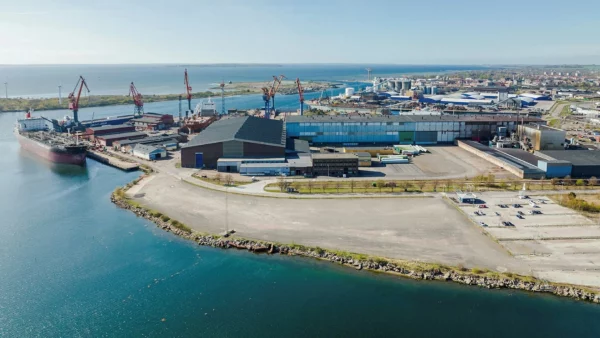
Polar Structure expands into maritime infrastructure with acquisition in the Port of Landskrona
Stockholm, 15 October 2026 – Polar Structure has today completed the acquisition of a shipyard and industrial port area in the Port of Landskrona, sou...
Read more
From leading the maturing LoRaWAN market to helping transform a global tech sector
The Netmore Group – a Polar Structure subsidiary specialized in connectivity and Internet of Things (IoT) – has been busy. Through equal parts orga...
Read more